2025.10.7
Announcing the Winners of CEATEC AWARD 2025
The Minister for Internal Affairs and Communications Award, The Minister of Economy Trade and Industry Award, The Minister of Digital Agency Award, and Category Awards including the Newly Established Mobility Award

The Japan Electronics and Information Technology Industries Association (JEITA: Kei Uruma, Representative Director and Chairperson; also President and CEO of Mitsubishi Electric Corporation) is pleased to announce the recipients of CEATEC AWARD 2025, including the three ministerial awards – The Minister for Internal Affairs and Communications Award, The Minister of Economy, Trade and Industry Award, and The Minister of Digital Agency Award – as well as Category Awards including the newly established Mobility Award, all of which are selected from projects, technologies, products, and services as well as the software, applications, components, devices that support them, on display at CEATEC 2025. The CEATEC AWARD 2025 review board panel of judges has selected the CEATEC AWARD 2024 to be implemented with the goal of realizing Society 5.0, which will contribute to the creation and development of new value and markets while invigorating related industries.
◆ The Minister for InternalAffairs and Communications Award
Compact and Lightweight LEO Satellite Communication User Terminal
Integrated with Electronically-steered Phased Array Antenna (prototype)
by Sharp Corporation
◆ The Minister of Economy, Trade and Industry Award
A Platform for Deepening Mutual Interpretations Through Pain Sharing
by NTT Docomo
◆ The Minister of Digital Agency Award
Mask Voice Clip—A Mask-Attached Device for Achieving
Reliable Voice Input in the AI Era
by Murata Manufacturing Co., Ltd
Please refer to the following pages for the outline and assessment of the Ministerial Awards,
as well as the details of the Category Awards.
The Minister for Internal Affairs and Communications Award
Compact and Lightweight LEO Satellite Communication User Terminal Integrated with Electronically-steered Phased Array Antenna (prototype)
Sharp Corporation
(General Exhibits|Booth No.: 3H223)

Outline:
Prototype of a compact and lightweight low earth orbit (LEO) satellite communication user terminal integrated with electronically steered phased array antenna utilizing miniaturization and lightweight design technologies and communications technologies accumulated through the development of smartphones. This terminal device is applicable for various uses such as construction and agricultural machineries, vessels and ships, vehicles, drones and more.
Assessment:
A low earth orbit (LEO) satellite communication is expected to be utilized in areas where cellular communications are unavailable, such as on the sea or in mountainous regions. There is high demand both in Japan and overseas, and the user terminals require the excellence in quality such as compactness and lightweight, which are associated with products made in Japan. Making use of its expertise acquired through the development of smartphones, Sharp has successfully achieved significant downsizing and weight reduction compared to conventional user terminals for LEO satellite communication. Demand for energy-efficient, compact and lightweight terminals are high, not only for satellites, but also for highaltitude platform stations (HAPS)*1, drones and other aircrafts. Sharp’s award-recipient prototype is compatible with 5G non-terrestrial networks (NTN), and the company is aiming for standardization after 2030. It was highly evaluated for a technology to support the infrastructure in the future, highly anticipated to demonstrate Japan’s presence in next-generation communication standards.
*1: HAPS (High Altitude Platform Station): An unmanned flying base station using an aircraft or airship that operates in the stratosphere (at an altitude of 20 km).
*2: 5G NTN (Non-Terrestrial Networks): Integrates satellites and HAPS in a multi-layer network that functions as a base station, enabling 5G communication in areas beyond terrestrial coverage. Currently standardized NTN modes include IoT-NTN and NR-NTN.
The Minister of Economy, Trade and Industry Award
A Platform for Deepening Mutual Interpretations Through Pain Sharing
NTT Docomo, Inc.
(General Exhibits|Booth No.: 1H007)
Outline:
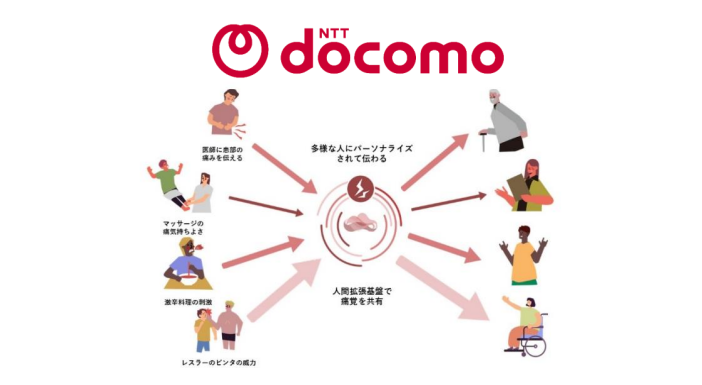
This is the world’s first* platform technology for sharing the perception of pain—one of the more difficult human sensations to put into words. Conveying to another the physical and psychological pain one feels is challenging: the other party often has to rely on subjective interpretations, making objective analysis difficult. However, this technology makes it possible to experience and appreciate another person’s pain as if it were one’s own. As well as contributing to better communication in healthcare, it can be used to support victims of abusive behavior and defamation on social media.
*Source: NTT DOCOMO
Assessment:
As the world’s first technology to quantify the pain felt by an individual, something that has been very difficult to assess objectively, this enables the sharing of pain in a way that another person can understand. The same stimulus is experienced differently by different people, but by analyzing the brainwaves associated with sensory perception, this technology quantifies the perception of pain so it can be shared. Although it is currently limited to the pain produced by an external stimulus, future goals include detecting inner/psychological pain and quantifying the perception of smell and taste. Drawing on data stored in DOCOMO’s Human Augmentation Platform™, it compares and evaluates differences between the person directly experiencing pain and the person seeking to understand that experience. This enables the sharing of sensations and movements in a way that is optimized for the latter party. As well as the originality of this technology, the creation of this platform was highly evaluated. There is a wide range of potential applications, beyond the treatment of physical pain—for example, optimizing training regimes in the world of sports, creating immersive experiences for entertainment, and detecting/evaluating damage that is difficult to visualize, such as psychological harm resulting from abusive behavior by customers or defamation. There are high hopes regarding its future utility, including its social impact, unique perspective, and the potential for co-creation.
The Minister of Digital Agency Award
Mask Voice Clip—A Mask-Attached Device for Achieving Reliable Voice Input in the AI Era
Murata Manufacturing Co., Ltd.
(General Exhibits|Booth No.: 2H325)
Outline:
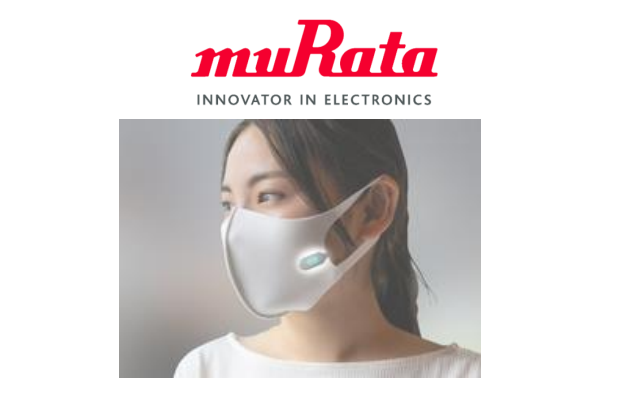
With the evolution of large language models (LLMs), the sort of natural language operations—including data input and record-keeping—that until now seemed futuristic are fast becoming reality. However, they demand reliable voice input, which the hardware of this device is able to deliver. By detecting minute vibrations on the mask surface with a piezoelectric film sensor, it can extract just the voice of the maskwearer, in real time and with high accuracy—even in noisy environments and when other people are talking at the same time. This technology facilitates the adoption of AI in many different fields, such as healthcare and manufacturing, as well as for maintenance inspections, etc.
Assessment:
The structural design of this device provides it with sound-source selectivity and noise resistance, enabling it to accurately capture only the speaker’s voice, even in a noisy environment. A sensor clipped inside the mask directly detects the vibrations produced when the wearer speaks, allowing it to deliver a high-quality audio signal. Since it only detects the speaker’s voice, it is expected to surpass the performance of existing noise-canceling technologies, improving voice input and enhancing speech recognition in noisy environments. It was highly evaluated for its utility as a next-generation interface for voice input in environments with ambient noise or settings requiring mask-wearing, such as factories and hospitals. Voice capture and speech recognition for people wearing masks have proved challenging, but thanks to this device masks no longer need to be seen as an obstacle. Furthermore, expectations are high for this device’s future potential, including applications unrelated to masks and silent speech input.
Category Awards
■ Innovation Category
ZINNSIA—A Sensor Interface that Transforms a Broad Range of Materials into Touch Controls and Switches
Japan Display Inc.
(General Exhibits|Booth No.: 2H202)
Outline:
ZINNSIA is an innovative, high-sensitivity sensor interface that transforms a broad range of materials including wood, stone fabric, and drywall. For instance, one can step on a floor surface to turn on the light intuitively by installing the sensor underside a floor. The sensor comes in a sheet form, which can be simply attached to the back of a material, enabling for flexible installation tailored to the shape and application. It provides new interactive experiences while enhancing freedom in spatial design without compromising material texture or aesthetic appeal.
Assessment:
While utilizing the same capacitive sensing technology as smartphone touch panels, ZINNSIA sensor offers high sensitivity, low noise, and fast response times while enabling sensing through materials over 10 cm thick. It allows operation while preserving the texture and shape of various materials, even thick wood, plastic, or leather, thereby expanding the applications and usability of touch sensors. From the amusement industry seeking to draw “Is this the control panel?” kind of surprises, to embedding it into car interiors where parts of the interior become control panels, and even as a trigger for home automation in residential equipment—with ZINNSIA, any everyday object can become a touch panel. Its potential to become a breakthrough that generates new applications and services was recognized.
■ Innovation Category
Multilingual Simultaneous Translation and Multiple Sound Spot Synthesis
National Institute of Information and Communications Technology (NICT)
(General Exhibits|Booth No.: 1H009)
Outline:
NICT's solution combines AI-powered multilingual simultaneous interpretation with multiple sound spot technology. By segmenting speech recognition results into shorter units (chunks) for real-time translation, the system delivers fast and accurate interpretation of continuous speech. In parallel, through combinations of multiple speakers, the system provides synthesized audio for each language area, while also displaying the translated text on screen.
Assessment:
A solution that combines a highly accurate, low-latency multilingual translation system with multi-spot playback using 16ch speakers. A single voice is simultaneously translated and played back in multiple languages, while multi-spot speakers play back the desired audio to the people who you want it to be delivered. Simultaneous multilingual interpretation for multiple people using AI and speakers with noise cancellation technology enable separation of the audio for the areas where it is to be delivered. Already implemented in society, for example as a simultaneous interpretation application at the Osaka Expo, the system has been recognized as a technology that will increase the satisfaction of visitors to Japan and greatly expand inbound demand to local regions.
■ Innovation Category
A Sensor System with Real-time Learning Using an Analog Reservoir AI Chip
for Edge Computing
TDK Corporation (General Exhibits|Booth No.: 6H180)
Outline:
Power consumption and latency due to reliance on cloud AI by generative AI are major obstacles to the development of AI. Reservoir AI is technology that mimics the human cerebellum and excels at processing time-series information for robotics, human interfaces and so forth. Reservoir AI can reduce the size of the learning part in the reservoir through natural phenomena and can be applied to sensors tailored to the user's individuality through real-time learning while using AI with edge applications.
Assessment:
Increased global demand for power and communication delays have become problematic with the increasing use of AI. Therefore, power-saving, low-latency reservoir AI is required not only for cloud computing but also for edge applications. This solution is AI that operates similar to the action of the cerebellum when compared to the human brain. Together with spin-memristors*, which are neuromorphic devicesthat perform processing similar to the cerebrum, this solution has led to power-saving, low latency and high-speed processing. Hopes for new innovations and for the wider use of AI in the future have been expressed as AI is expected to be used in robot-related sensors, human interfaces, and other areas where reaction speed is required.
*An analog device that mimics the synapses of the human brain.
Recipient of the CEATEC AWARD 2024 Innovation Category Award.
■ Innovation Category
Frontline Coordinator – Naivy: Next-generation AI Agent
Hitachi, Ltd. (General Exhibits|Booth No.: 5H220)
Outline:
Naivy is an AI agent developed to support on-site operational decision-making by personnel engaged in manufacturing, inspections, maintenance, etc. AI has been harnessed for use in the physical domain to improve the efficiency of workers at the same time as reducing their workload. AI performs real-time analysis of what is happening on site and compares this with domain knowledge stored in a proprietary metaverse space. This world-first* technology is thus able to identify the equipment requiring attention. It
then provides on-site personnel with intuitive and easy-to-understand navigation for appropriate work procedures according to the situation.
*Source: Hitachi, Ltd.
Assessment:
To help address increasingly serious labor shortages and the lack of skilled personnel, this AI agent provides support for inexperienced workers by drawing on the skills and knowledge of experienced professionals—stored and generated in a metaverse space—to display in 3D the necessary information, offering clear onsite solutions to problems and issues arising in the field. Naivy, whose specialty is primarily maintenance and inspection tasks, has been evaluated as contributing to solving diverse challenges. As well as addressing the shortage of experienced workers through knowledge systematization and intergenerational skills transfer, this AI agent also facilitates efficient remote management of multiple sites, reducing the psychological burden on field workers, and fostering their sense of job fulfillment.
■ Innovation Category
Chip-on-wafer Direct Bonding Technology that is Environmentally Friendly
Yamaha Robotics Co., Ltd., AIST, Tokyo University of Science
(General Exhibits|Booth No.: 4H220)
Outline:
To manufacture the advanced devices required in a post-5G society, it is necessary to use direct bonding to join multiple semiconductor chips in a 3D configuration with chip-on-wafer technology. However, conventional methods result in foreign particles being left on the surface of semiconductor chips after wafer dicing; this residue affects bonding quality and prevents practical application of 3D stack technology. To solve this problem, technologies have been developed (1) to clean and pre-treat the semiconductor chip surface, and (2) to implement completely non-contact chip handling.
Assessment:
To make AI modules perform faster and offer higher performance, advances have been made in the multilayering and integration of semiconductors and cache memory, and new techniques like direct bonding have been adopted. However, production yields have been impacted by residue left on the chip surface following dicing. These new technologies result in a systematized approach to foreign particle removal through the use of ultrasonic non-contact handling and hydrogen water microbubbles. They have been evaluated as key component technologies that will contribute to advancing and galvanizing the entire semiconductor industry. Practical applications are eagerly anticipated.
■ Innovation Category
Heart Rate Sensing for Bathing
Rinnai Corporation
(General Exhibits|Booth No.: 1H318)
Outline:
To achieve sustainably healthy and enriched living, Rinnai starts by sensing heart rate during daily bathing
activities to predict physical and mental states, provide feedback on effects of bathing, and propose
personalized bathing methods, and relaxation and lifestyle habits. Rinnai has created this electrocardiogram measurement module for bathing.
Assessment:
Sensing the heartbeat during the daily bathing routine to predict the state of the body and mind. Through non-contact and unconscious sensing during bathing, this system records changes in physical conditions to offer healthy lifestyle suggestions and propose bathing methods. In addition to detecting heartbeats, the system can also detect elevated body temperature and is highly regarded as a technology that can address not only therapy but also everyday health issues, such as detecting hot flashes in advance, preventing accidents that may occur in the bathtub, and providing monitoring in the aging society by notifying people of danger.
■ Next Generation Category
Feel It, Touch It—The Next Generation of 4D Video
TouchStar (Commercialization Project, Tohoku University)
(Next Generation Park|Booth No.: 5H322)
Outline:
As a next-generation vibration feedback technology that goes beyond the conventional limits of smartphone vibrators, TouchStar delivers natural and immersive haptic experiences. Utilizing a proprietary algorithm that originated from university research, TouchStar enhances both video and audio with a vivid sense of physical realism through a faithful reproduction of a wide-range of haptic sensations—from high to low frequencies. At the show floor, the group of researchers from Tohoku University unveiled experiential content for the first time, integrating smartphones with digital signage, while showcasing the potential for new experiential content that conveys the skill and subtle breathing of performers.
Assessment:
TouchStar, which began as a commercialization project originating from Tohoku University, is preparing for its launch with the vision “to create a world where tactile experiences can be archived and shared.” It automatically generates tactile signals from audio signals, converting them into more realistic experiences even on devices with narrow vibration frequency ranges, such as the vibration function found in smartphones. Expectations are high for its future potential to create new experiences by integrating touch with video and audio, and to generate social and cultural value, including applications beyond smartphones.
■ Next Generation Category
ReaLab AI - Autonomous AI Agents Powering the Research Landscape, from Exploration to Lab Experiments
Rohto Pharmaceutical Co., Ltd. / Hutzper Inc.
(Next Generation Park|Booth No.: 6H150)
Outline:
Target Discovery AI Orchestrator for Healthcare and Life Sciences:
An AI agent for all R&D areas requiring target discovery. Automatically creates experiment designs based on understanding of researcher intentions, and automatically finds and evaluates optimal gene expression data from public databases. Large-scale bioinformatics analysis is then performed seamlessly in the cloud. Generative AI manages and automates the entire process, enabling rapid and reproducible drug target candidate discovery, regardless of expertise. Practicality has been proven by Rohto Pharmaceutical. “Dual-agent AI for Autonomous Prescription Design and Experiment Execution”:
An AI platform that integrates prescription research and robotic experimentation, automatically generating “design → plan → execute → record” by simply instructing researchers in natural language. This is not just a research-level trial, but a system in which AI interprets and converts complex control rules for experiment robots to prevent mistaken operations and ensure reproducibility and safety while also handling actual operations. The technology can be deployed in various fields such as cosmetics, pharmaceuticals, chemicals and foods, and its practicality has already been demonstrated by Rohto Pharmaceutical, a codeveloper of the product.
Assessment:
As AI is utilized in the healthcare and life science fields, such as drug discovery, there are still issues to be addressed, such as improving efficiency in the R&D environment, which tends to be dominated by human labor. AI supports the research process all the way from pre-processing to analysis of acquired data thus freeing researchers from tasks that require experience and expertise, such as finding target data in huge databases, mastering difficult tools, setting up experiments and operating equipment. This enables researchers to make more effective use of their knowledge and experimental equipment and improve the return on their investments. As research becomes more expensive every year, this AI agent was highly evaluated for its contribution to the acceleration of research and development, the economic effects of laboratory automation, and the resulting evolution and acceleration of medical care. The judging committee decided to award the prize to "Target Discovery AI Orchestrator for Healthcare and Life Sciences" and "Autonomous Prescription Design and Experiment Execution with Dual-Agent AI" together.
■ Co-creations Category
Cross-industry Co-creation Transforming Beauty & Healthcare—Future Innovation Driven by RNA from KAO, istyle, and KIRIN
RNA Co-Creation Consortium
(Partners & Global Park|Booth No.: 4H213)
Outline:
In the beauty and healthcare markets, a wide range of product offerings continues to drive market growth. However, from the consumer’s perspective, the overwhelming abundance of products and information makes it increasingly difficult to identify what truly provides value for them.
RNA Co-Creation Consortium provides a cross-industry framework that enables personalized product selection and delivery. Through their newly developed classification technology based on gene expression data (skin gene expression mode analysis) and co-creation with Japan’s largest beauty platform as well as leading beauty and healthcare manufacturers, the consortium is driving societal transformation.
Assessment:
RNA contained in sebum has been made visible through “sebum RNA monitoring,” showing how it changes due to environmental factors such as diet, stress, and UV exposure. Because RNA exists exceptionally stably within facial sebum, RNA measurement—previously requiring invasive procedures like blood draws or excisions—can now be performed non-invasively, advancing its application in the health and wellness field. Currently, social implementation is progressing, such as integrating a service into a partner app that uses AI to analyze and estimate RNA data from selfies taken with a smartphone camera, enabling users to select cosmetics suited to their skin condition at that moment. As an innovation born from co-creation, it is anticipated that future co-creation will expand, and applications will diversify. It is also expected to elevate the entire industry, including cosmetics manufacturers. Consequently, it was highly regarded as a technology worthy of the Co-creations Category Award.
■ Mobility Category
Feeling
Humonii (Japan Mobility Show 2025, Startup Exhibitor
Outline:
One in three wheelchair users tend to suffer from depression, which is an enormous psychological toll. Therefore, wheelchair users need support to give them a sense of self-efficacy and lead proactive lives. Humonii’s “Feeling,” is an all-in-one hands-free semi-automatic wheelchair with core-based operation that supports a proactive future from the time of hospitalization to self-actualization after discharge, such as 1) Proactive in-hospital living in hospitals and nursing homes, 2) Expansion of work that the user can handle, 3) Support for participation in sports and recreation, etc.
Assessment:
As Japan becomes a super-aging society, the number of wheelchair users is expected to increase going forward. Even non-elderly people may need a wheelchair as they regain their faculties after an injury or illness. Issues have surfaced with wheelchair users in these situations such as the tendency to suffer from depression, which is a serious psychological burden caused by the loss of self-efficacy. Humonii’s “Feeling” is a belt-type interface for electric wheelchairs that can be retrofitted to existing electric wheelchairs to enable the user to control the wheelchair through the movement of the core of the body. The system converts pressure applied to a belt worn by the wheelchair user into a control signal to enable hands-free operation. In addition to rehabilitating effects on wheelchair users, even able-bodied people can experience a sense of self-transcendence through experiences that exceed their own abilities. “Feeling” has been highly acclaimed for its potential as a next-generation mobility system offering solutions to social issues and a wide range of future uses, including improved convenience for wheelchair users, rehabilitation effects, and expansion of physical capabilities as entertainment.
About CEATEC AWARD 2025
The CEATEC AWARD 2025 Review Panel of Judges will review the technologies, products, and services exhibited at CEATEC 2025 (with the exception of the Mobility Category), from among the entries of exhibits and projects submitted in advance by exhibitors, and award those that are deemed highly innovative and outstanding from academic and technical perspectives, as well as marketability and future potential.
■ Judging Criteria of Each Award
1. Ministerial Awards (in the order of establishment)
The Minister for Internal Affairs and Communications Award
This award recognizes candidates judged to make the greatest contribution to the development in the growth of future digital society, including the innovative utilization of information and communications, networking, data, AI and IoT technologies in the digital age, the provision of services using these technologies and digital utilization in local communities, will be selected for the award. In particular, the most outstanding project, technology, product, service, or supporting software, application, etc. that are evaluated to make the greatest contribution to solving issues and challenges across Japan including digital transformation (DXing) of local government, regional community DX, further evolution of information communications, social implementation of IoT and AI, cybersecurity, broadcasting infrastructure, disaster prevention and mitigation, open data promotion, and promoting efficiency and high added value in economic activities will be awarded the CEATEC AWARD 2024 Minister for Internal Affairs and Communications Award.
Minister of Economy Trade and Industry Award
This award recognizes candidates that are most likely to contribute significantly to the development in the growth of future digital society, which will generate new value in digital society and economy using innovative technologies such as AI, quantum computing, and robotics, as well as projects that drive solutions and transformation in daily life, society, business and industry; innovative manufacturing; service leveraging IoT; and cross-cutting technological development that advances industrial DX, will be selected
for the award. In particular, for the most outstanding products, devices, services, or supporting software and applications that solve diverse challenges nationwide—such as advancing green transformation (GX), supporting industrial digital transformation (DX), smart manufacturing, quantum technology, promoting open innovation, utilizing generative AI, next-generation mobility, and next-generation batteries—and that
enhance the efficiency and high value-added nature of social and economic activities—will be awarded the CEATEC AWARD 2025 Minister of Economy, Trade and Industry Award.
The Minister of Digital Agency Award
This award is presented to entrants that best contribute to the creation of a prosperous lifestyle and a strong society for the future, such as systems or services that realize the diversity of the happiness of individuals and ensure that no one is left behind in the digital society. In particular, the CEATEC AWARD 2025 Minister of Digital Agency Award is presented to the most outstanding products, services, supporting software, applications, etc., that solve various issues throughout Japan such as service design, including cyber security measures and service design for people with disabilities, and promote efficiency
and high added value in social and economic activities.
2. Category Awards
Innovation Category Award
This award is presented for proposals for new technologies, products, services, software, applications,
solutions, and business models that contribute to the sustainable upkeep and prosperous development of industry, business, society, and lifestyles, and are evaluated as advanced and for their specificity and social contribution in line with the realization of Society 5.0.
Next Generation Category Award
This award recognizes startup companies, universities and research institutions that have developed
advanced technologies, products, services, software, applications and business models and are working to bring them to market. Entries are evaluated comprehensively on the basis of their practical applicability, social contribution, technological capabilities, marketability, and other factors.
Co-creation Category Award
This award category is open to technologies, products, services, software, applications, solutions, business models, etc. co-created by companies in diverse industries and business sectors based on unique themes for the realization of Society 5.0. Winners are selected based on their advanced nature and contribution to the future society.
Global Category Award
*To be announced during CEATEC 2025 due to on-site judging.
This category is for exhibitors from outside Japan. Winners are selected based on actual feasibility and their contribution to society.
Mobility Category Award
*Newly established category
Selected from startup exhibitors at this year's Japan Mobility Show 2025 (Thursday, October 30 - Sunday, November 9, Tokyo Big Sight), this CEATEC AWARD 2025 is presented to companies evaluated for their potential for practical application and contribution to society.
■ CEATEC AWARD 2025 Review Panel of Judges
Academic Societies (in no particular order)
・Information Processing Society of Japan (IPSJ)
・The Institute of Electronics, Information and Communication Engineers (IEICE)
・The Institute of Image Information and Television Engineers (ITE)
・The Institute of Electrical Engineers of Japan (IEEJ)
Research Institutes and Media Related (in no particular order)
・MM Research Institute, Inc.
・The Nikkan Kogyo Shimbun, Ltd.
・Nikkei Business Publications, Inc.
・ITmedia, Inc.
・Techno-core Corporation
・Woven Capital Management Company, LLC
Observers
Ministries (in the order of establishment)
・Ministry of Internal Affairs and Communications (MIC)
・Ministry of Economy, Trade and Industry (METI)
・Digital Agency of Japan
Japan Electronics and Information Technology Industries Association (JEITA), CEATEC 2025 Organizer Communications and Information network Association of Japan (CIAJ), CEATEC Co-organizer Software Association of Japan (SAJ), CEATEC Co-organizer Japan Automotive Manufacturers Association, Inc. (JAMA), CEATEC Supporting Organization Tribeat Co., Ltd.
CEATEC 2025 Official Website: https://www.ceatec.com/en/
Name: CEATEC 2025
Dates: October 14 (Tue.) ~ 17 (Fri.), 2025
Venue: Makuhari Messe
Admission: Free of charge (registered admission required for all visitors)
Organizer: Japan Electronics and Information Technology Industries Association (JEITA)
Co-Organizers: Communications and Information network Association of Japan (CIAJ)
Software Association of Japan (SAJ)
Back to list